What to Consider when it Comes to SOC 2 vs ISO Certifications
In today’s digital environment, organizations face increasing expectations around data security, privacy, and operational resilience. At Tevora, we understand that compliance with recognized frameworks is a way to strengthen security posture, manage risk, and build trust with customers.
Two of the most common paths we see are SOC 2 and ISO 27001. Both validate security maturity, but they do so in different ways for different audiences. This article explains the distinctions and provides guidance to choose the right framework for your organization.
Let’s Begin with- What Is SOC 2?
SOC 2 stands for System and Organization Controls . It is an auditing framework developed by the American Institute of Certified Public Accountants (AICPA) and is designed for service organizations such as SaaS providers, data centers, and managed service firms that handle customer data.
SOC 2 evaluates five Trust Services Criteria: security, availability, processing integrity, confidentiality, and privacy. You can read more about these criteria in our SOC Audit Services overview.
There are two types of SOC 2 reports. SOC 2 Type 1 evaluates the design of controls at a specific point in time. SOC 2 Type 2 evaluates both design and operating effectiveness over a period, usually six to twelve months. Tevora’s SOC 2 guide explains how these reports provide independent validation that your organization’s internal controls meet rigorous standards for protecting client data.
Our team also offers SOC 2+ services, which integrate SOC 2 with other frameworks such as ISO and HIPAA. This approach helps organizations streamline compliance across multiple requirements.
What Is ISO 27001?
ISO 27001 is part of the ISO/IEC 27000 family and defines the structure for an Information Security Management System (ISMS). It provides a comprehensive system of policies, processes, and controls to protect data across an organization and is a risk-based approach.
ISO focuses on establishing, implementing, maintaining, and continually improving an organization’s information security management system. More details on our approach can be found in Tevora’s ISO 27001 success guide.
ISO 27001 certification supports alignment with other standards and regulations, including GDPR, HIPAA, and NIST. You can learn more about our services on the ISO Audit Services page.
Additional ISO standards often implemented alongside ISO 27001 include ISO 27017 for cloud security, ISO 27018 for cloud PII privacy, ISO 27701 for privacy information management, ISO 22301 for business continuity, and ISO 42001 for AI management systems.
Some highlights around ISO Certification include:
- It provides a holistic approach to information security management, encompassing people, processes, and technology.
- ISO 27001 is globally recognized and often requested by organizations across different industries.
- ISO 27001 Management Clauses forms the backbone of the information management system, while the controls from Annex 27002 provides the controls. ISO 27001 requires organizations to establish a formal ISMS structure that creates accountability and governance requirements.
What is in Scope for SOC 2 and ISO
SOC 2
SOC 2 covers organizational controls as well as system (technical) controls. The scope starts with the service or platform as the customer sees it, and then includes all components required to deliver that service, product, or platform (including processes, teams, policies, infrastructure, data protection, etc.).
ISO
ISO has stricter organizational focus, but both frameworks review a comprehensive set of controls (policies, procedures, organization items, system setting, physical security etc.). ISO is broader in scope but also covers customer data as a key component.
Geographical Factors for SOC 2 and ISO
SOC 2
SOC 2 is primarily US focused. SOC 2 can be combined with C5 to meet the equivalent of SOC 2 for Europe. Other frameworks can be added to SOC 2 as well-such as AU CDR for Australia customers.
ISO
ISO is broadly accepted and recognized across the EU and international countries.
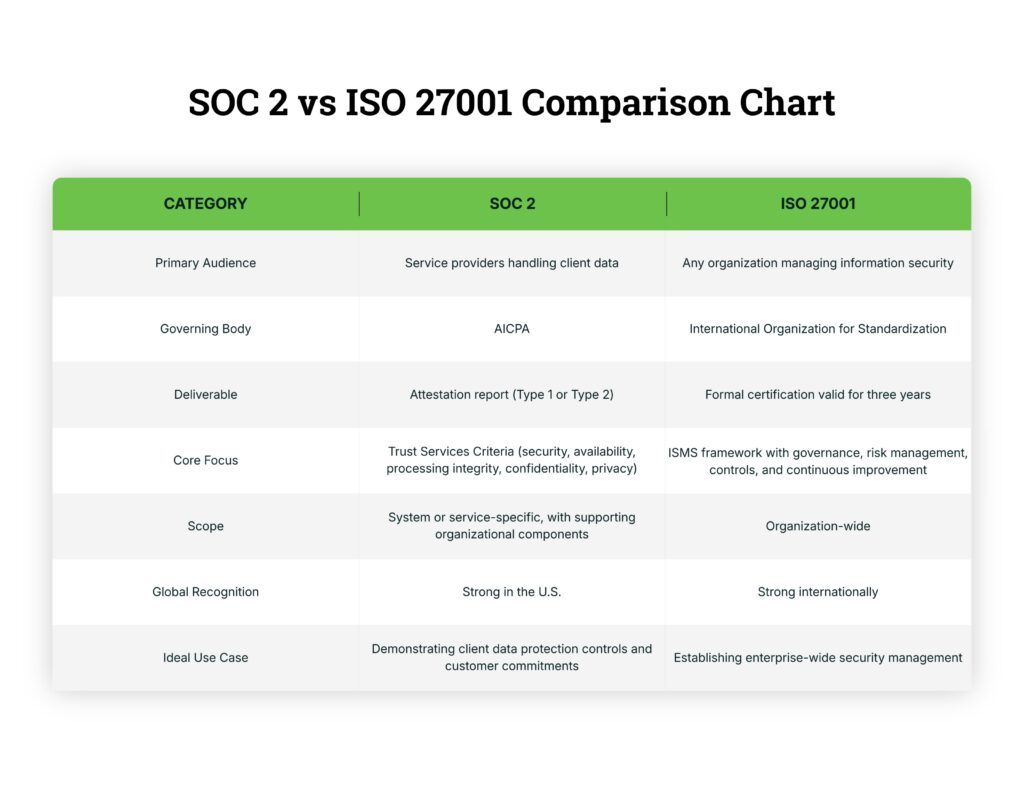
There is a significant overlap between SOC 2 and ISO 27001. Organizations often pursue both, using SOC 2 for client assurance and ISO 27001 for operational governance and international recognition. Our SOC 2+ approach helps combine these frameworks efficiently to reduce redundant efforts.
Tevora’s SOC Expert Support
- Readiness Assessment-Establish the scope of the attestation and SOC obligations, evaluating your current vs. Desired state and making treatment recommendations.
- Remediation-Ensure the right controls and processes are in place, providing supplemental GRC support where needed to be implemented.
- Attestation-Assess adherence to SOC control requirements and ensure the attestation report reflects system boundaries, control design, and process implementation.
Tevora’s ISO Expert Support
- Gap Assessment-Assess performance against chosen standard(s).
- Risk Assessment-Assess relevant assets, processes, and technologies.
- Internal Audit-Evaluate effectiveness of measures.
- Remediation Services- Address gaps with actionable recommendations and support.
- Audit Assistance and Support-Day-of external audit guidance as needed.
How to Decide Which Framework Fits Your Organization
Choosing between SOC 2 and ISO 27001 depends on your organization’s structure, customer expectations, and long-term growth strategy. At Tevora, we guide clients through this decision using readiness assessments and gap analyses that clarify not only which framework fits best today, but also which supports their future compliance roadmap.
Here’s how we help organizations evaluate the right path:
1. Understand Your Market and Customer Expectations
If your organization primarily serves U.S.-based clients—especially in SaaS, financial services, or healthcare, in which SOC 2 is often the expected standard. Many enterprise clients specifically request a SOC 2 Type 2 report as part of vendor due diligence.
If you have international clients, or if your business operates in regions governed by GDPR or other global privacy laws, ISO 27001 may be the better fit due to its worldwide recognition.
2. Define Your Compliance Objectives
SOC 2 results in an independent attestation report, while ISO 27001 leads to a formal certification.
While both meet the general needs of an information security compliance effort, the distinction matters; it is important to confirm if a specific SOC 2 Attestation or ISO Certification is required by your partners or customers.
If you need a globally recognized certification for bids or partnerships, ISO 27001 often carries more weight.
3. Consider Timeline and Resource Commitment
SOC 2 Type 1 can often be achieved within a few months, while ISO 27001 certification typically requires six months to a year depending on scope and readiness. ISO 27001 also includes ongoing surveillance audits to maintain certification.
Organizations seeking a faster path to market often start with SOC 2, then expand to ISO 27001 once their ISMS matures.
4. Explore an Integrated Compliance Strategy
Many organizations find value in combining frameworks. Through our SOC 2+ methodology, we help clients align controls across multiple frameworks, reducing redundant audits and simplifying documentation. This integrated approach allows for greater scalability as regulatory expectations evolve.
Conclusion
Both SOC 2 and ISO 27001 enhance credibility and strengthen security posture. SOC 2 is best for service providers needing U.S.-recognized reports for client assurance. ISO 27001 is ideal for enterprise-wide information security management with international recognition. For organizations that operate globally or serve clients in multiple regions, pursuing both can provide a comprehensive compliance strategy.
At Tevora, we help organizations navigate these frameworks, perform readiness assessments, implement controls, and achieve certification or attestation efficiently. More information on our ISO and SOC services is available on our ISO Audit Services and SOC Audit Services pages.