Stop Guessing Your Security Maturity: A Practical Guide for CISOs Using the NIST Cybersecurity Framework
Security leaders are increasingly being asked a question that sounds simple but is difficult to answer clearly:
How mature is our cybersecurity program?
For many CISOs, the challenge is not a lack of security work being done. Controls are in place, tools are deployed, and teams are responding to threats every day. The challenge is translating that work into something leadership can understand. Boards are not asking about patch cycles or endpoint coverage. They are asking about risk, resilience, and whether the organization’s security program is improving over time.
This is where many security programs struggle. Without a structured way to measure maturity, organizations often rely on informal scoring, subjective opinions, or internal spreadsheets. These approaches make it difficult to answer board-level questions with confidence.
Using the NIST Cybersecurity Framework provides CISOs with a flexible and practical way to move beyond guesswork. It offers a structured method to evaluate capabilities, identify gaps, and present cybersecurity maturity in a way that aligns with risk management and executive oversight.
For CISOs tasked with explaining security posture to leadership, a maturity assessment built around this framework can transform the conversation.
Why security maturity questions are becoming more common
Board oversight of cybersecurity has increased significantly over the past several years. Regulatory expectations, cyber incidents, and supply chain risk have pushed cybersecurity from an operational concern into an enterprise risk issue.
Executives and board members are now asking questions that go beyond technical controls. They want to understand whether the organization’s security program is improving, how it compares to industry expectations, and where additional investment may be needed.
Unfortunately, many security teams are not equipped with a clear path to answer these questions. Technical metrics such as vulnerability counts, alerts, or patch timelines do not provide a complete picture of organizational resilience. They show activity, but they do not show maturity.
Maturity assessments solve this gap by providing a structured way to measure capabilities across the entire security program. Instead of reporting isolated technical metrics, CISOs can present a comprehensive view of how well security processes, governance, and operational practices are functioning together.
Why informal maturity scoring often fails
Many organizations attempt to measure maturity internally before adopting a formal framework. Security teams might score their capabilities on a simple scale or attempt to map controls to internal policies.
While these approaches may offer some insight, they often introduce several problems.
First, they rely heavily on subjective interpretation. Two teams may evaluate the same capability differently depending on how they interpret the scoring criteria. This makes it difficult to produce consistent results or track improvement over time.
Second, internal scoring models rarely align with external frameworks or regulatory expectations. When auditors, regulators, or partners ask how security maturity was measured, organizations may struggle to explain the methodology.
Third, informal assessments often focus heavily on technical controls while overlooking governance and risk management processes. These areas are increasingly important as cybersecurity becomes more integrated with enterprise risk management.
Without a structured framework, maturity scores can become little more than educated guesses. For CISOs presenting results to the board, this lack of credibility can undermine the value of the assessment.
How the NIST Cybersecurity Framework enables structured maturity measurement
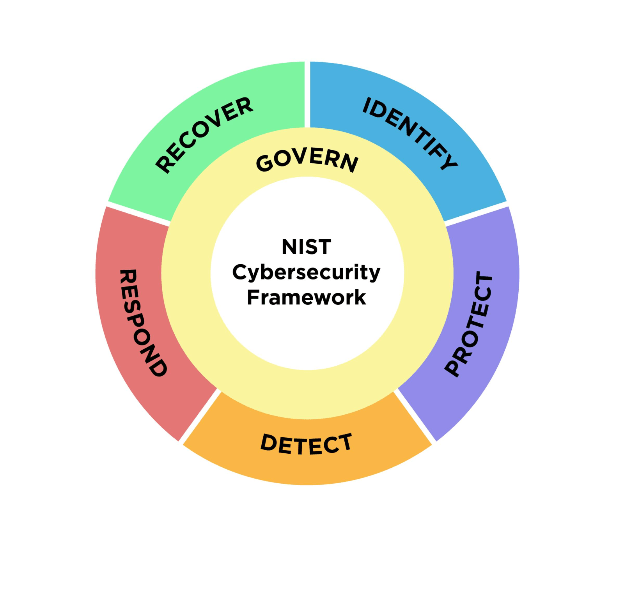
The NIST Cybersecurity Framework was designed to help organizations manage cybersecurity risk in a structured and repeatable way. It organizes cybersecurity capabilities into core functions that represent the lifecycle of managing and responding to cyber risk.
These functions include governance, asset identification, protection of systems and data, threat detection, incident response, and recovery planning. Together they provide a comprehensive view of how an organization prepares and responds to cyber threats.
When used as the foundation for a maturity assessment, the framework allows CISOs to evaluate security capabilities across each of these areas while also allowing flexibility in addressing key risks . Instead of focusing only on individual tools or controls, the assessment evaluates the effectiveness of processes, oversight, and operational readiness.
This structure makes it possible to measure maturity in a way that is consistent, repeatable, and aligned with widely recognized cybersecurity practices. It also allows organizations to track progress over time as capabilities evolve.
For CISOs, this creates a reliable foundation for answering the maturity question that boards are asking.
Translating security maturity into board-level insight
One of the most important outcomes of a cybersecurity maturity assessment is the ability to communicate results in a format that leadership can understand.
Boards do not need a deep technical breakdown of every control. What they need is a clear understanding of how well the organization manages cyber risk and whether the program is moving in the right direction.
A structured maturity assessment provides this clarity. By evaluating capabilities across the framework’s functions, CISOs can identify strengths, weaknesses, and areas where additional investment may be needed.
This information can then be translated into executive-level reporting that focuses on risk exposure, program progress, and strategic priorities. Instead of presenting dozens of isolated metrics, security leaders can show how different capabilities contribute to overall resilience.
Over time, this also allows organizations to demonstrate measurable improvement. As maturity increases across the framework’s functions, CISOs can show leadership that the program is evolving and that security investments are producing tangible results.
The growing role of governance in cybersecurity maturity
One of the most important updates in the latest version of the NIST Cybersecurity Framework is the increased emphasis on governance.
Cybersecurity is no longer viewed solely as a technical discipline managed within IT. It is increasingly treated as a core component of enterprise risk management. This shift means that leadership oversight, policy development, and accountability are now essential elements of security maturity.
For CISOs, this change reinforces the importance of demonstrating how cybersecurity decisions align with business risk management. A maturity assessment that includes governance capabilities can highlight whether roles and responsibilities are clearly defined, whether security policies are integrated with organizational risk management, and whether leadership has the visibility needed to oversee cybersecurity strategy.
This perspective resonates strongly with boards because it connects cybersecurity directly to business resilience and operational risk.
Turning your maturity assessment into a roadmap for improvement
Beyond reporting, maturity assessments provide one of the most valuable tools for guiding security program development.
By evaluating capabilities across the framework, organizations can identify where gaps exist and prioritize improvements based on risk. Some organizations may discover weaknesses in governance or third-party risk management. Others may find that incident response processes or detection capabilities need improvement.
The goal of a maturity assessment is not simply to produce a score. It is to create a clear roadmap that helps security teams focus their efforts on the areas that will have the greatest impact on risk reduction.
This roadmap also helps CISOs justify future investments. When security initiatives are tied directly to maturity improvements within a recognized framework, it becomes easier to demonstrate why certain capabilities need funding and how those investments support the organization’s risk management strategy.
Moving from uncertainty to measurable security posture
For many security leaders, the most difficult part of reporting to the board is the uncertainty surrounding maturity. Without a structured assessment, it can be challenging to determine whether the organization is ahead of the curve or falling behind industry expectations.
A maturity assessment built on the NIST Cybersecurity Framework helps remove that uncertainty. It provides a consistent method for evaluating cybersecurity capabilities and translating those results into meaningful insight for leadership.
Instead of relying on assumptions, CISOs can present a clear picture of how the security program performs across governance, protection, detection, response, and recovery. They can identify where improvements are needed and demonstrate how the program is evolving over time.
For boards that increasingly view cybersecurity as a strategic risk issue, this level of visibility is essential. Security maturity should not be a matter of opinion. With the right framework and assessment approach, CISOs can provide leadership with the clear, structured insight they need to understand and manage cyber risk.
Tevora Can Help
Tevora can help organizations develop and implement effective supply chain risk management strategies that are consistent with the principles laid out in CSF 2.0. Our experts are skilled in conducting detailed assessments to identify potential supply chain vulnerabilities, designing specific risk mitigation plans, and aiding with implementing controls and processes that improve supply chain resilience. Tevora can also advise on incorporating supply chain risk management strategies into current cybersecurity frameworks, guaranteeing comprehensive coverage and compliance with industry standards. This process can start with an evaluation of the organization’s existing supply chain risk management process, highlighting program-level gaps, and ensuring that best practices are followed.
If you have questions on managing or assessing supply chain risk in your organization, our experienced experts at Tevora can help. Just give us a call at (833) 292-1609 or email us at [email protected].
Authors