Where ISO 42001 Meets ISO 27001: A Side-by-Side Technical Deep Dive
Building a strong information security foundation is the prerequisite for deploying AI responsibly today. ISO/IEC 27001:2022, the globally recognized standard for information security management, is the natural launchpad for ISO/IEC 42001:2023, the first international standard governing AI management systems.
For companies looking to invest in an ISO 42001 exercise, it may be easier than you think.
Organizations that have already invested in ISO 27001 are better positioned than they might realize: ISO 27001 and ISO 42001 share a common High Level Structure (HLS), meaning their clause numbering, core terminology, and management system architecture are deliberately aligned to support integrated implementation.
So what exactly are the similarities and differences between the two related frameworks?
Here, we’ll break down how the two standards intersect in a clause-by-clause analysis. We’ll include the additional technical work each area demands to extend your ISO 27001 compliance efforts to ISO 42001.
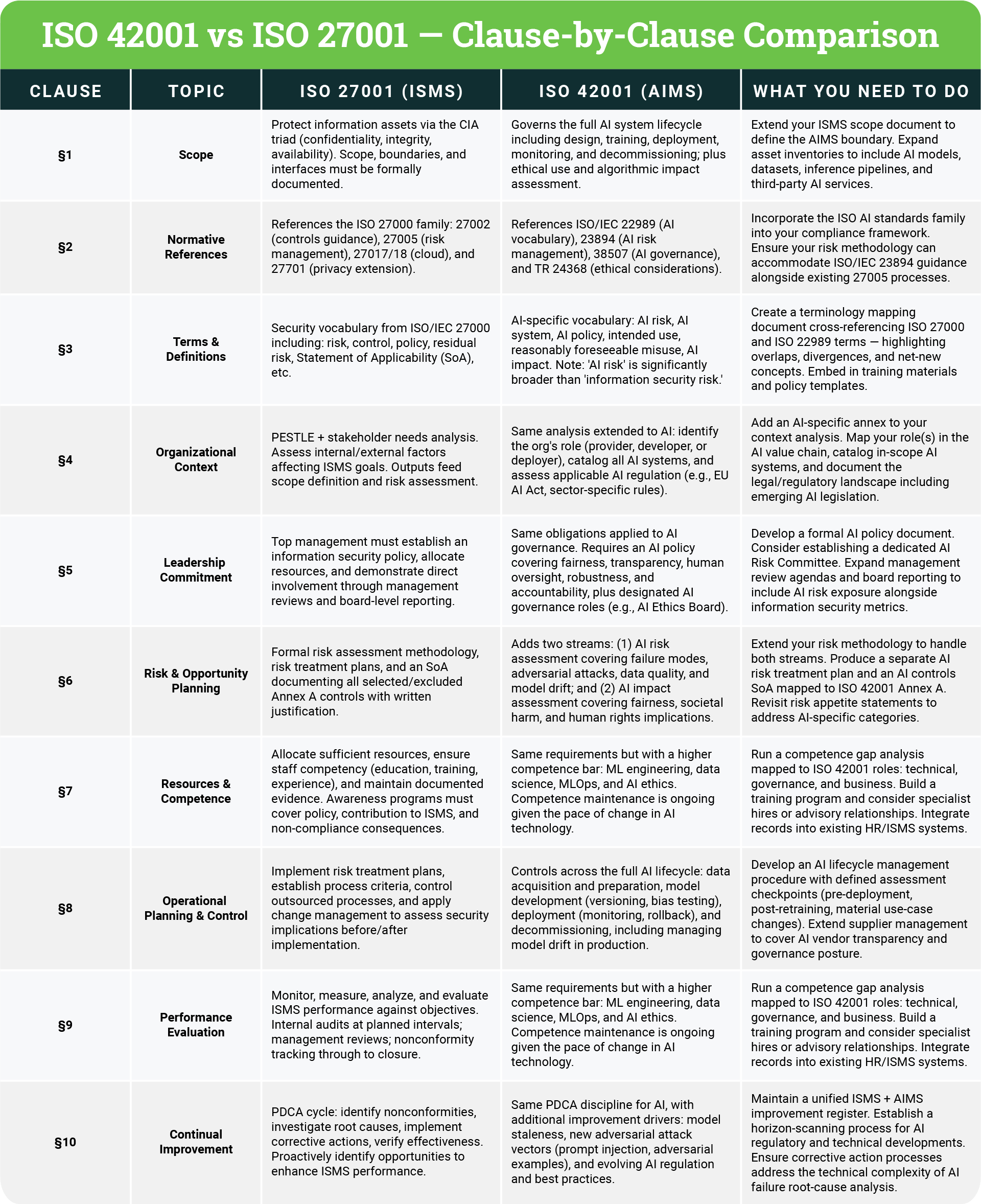
1. Scope
ISO 27001 defines the requirements for establishing, implementing, maintaining, and continually improving an Information Security Management System (ISMS). Its scope encompasses the confidentiality, integrity, and availability (CIA triad) of information assets across an organization. The standard uses a risk-based approach: organizations identify information assets, assess threats and vulnerabilities, determine risk appetite, and apply controls from Annex A (which maps to ISO/IEC 27002) to bring residual risk to an acceptable level. The scope of the ISMS must be formally documented, including the boundaries and interfaces between the organization and external parties.
ISO 42001 has a parallel structure but governs AI Management Systems (AIMS). Its scope extends beyond data protection into the lifecycle management of AI systems: from design and data acquisition through training, deployment, monitoring, and decommissioning. Crucially, ISO 42001 introduces concepts that have no direct equivalent in ISO 27001, such as AI ethical principles, algorithmic impact assessments, and obligations tied to the organization’s specific role in the AI value chain (provider, developer, or deployer). Annex A of ISO 42001 contains AI-specific controls, while Annex B provides implementation guidance.
How to Extend to ISO 42001: The ISMS scope document must be revisited and extended to formally define the AIMS boundary. This means identifying which AI systems fall within scope, documenting their interfaces with existing information assets, and articulating the relationship between the two management systems. In practice, many organizations implement the AIMS as a domain extension of the ISMS rather than as a fully separate system, which reduces duplication but requires careful mapping of where the two scopes overlap and diverge. Asset inventories maintained under ISO 27001 should be expanded to include AI models, training datasets, inference pipelines, and third-party AI services.
2. Normative References
ISO 27001 normatively references ISO/IEC 27000, which provides the vocabulary and foundational concepts for the entire 27000 family of standards. This creates a tightly integrated ecosystem: ISO 27002 provides control implementation guidance, ISO 27005 addresses information security risk management, ISO 27017 and 27018 extend controls to cloud environments, and ISO 27701 extends the ISMS into a Privacy Information Management System (PIMS). Together, these references establish a coherent technical architecture for managing information security risk.
ISO 42001 draws on a different but equally structured set of normative references. ISO/IEC 22989 provides the foundational vocabulary and concepts for AI systems, defining terms such as machine learning, neural network, training data, and inference. ISO/IEC 23894 specifically addresses AI risk management and provides detailed guidance on identifying and treating AI-specific risks, a direct counterpart to ISO 27005 in the security domain. Additional references include ISO/IEC 38507, which covers AI governance at the organizational level, and TR 24368, which addresses ethical concerns. These references collectively define the technical and ethical framework within which the AIMS must operate.
How to Extend to ISO 42001: The compliance framework’s reference architecture needs to be updated to incorporate the ISO/IEC AI standards family alongside the existing 27000-series references. Practically, this means ensuring that the risk management methodology can accommodate the guidance in ISO/IEC 23894, and that staff responsible for AI governance are familiar with the conceptual framework established by ISO/IEC 22989. Compliance gap analyses should be run against both normative ecosystems simultaneously to surface areas where the current controls may be insufficient for AI-specific requirements.
3. Terms and Definitions
ISO 27001 relies on a well-established vocabulary defined primarily in ISO/IEC 27000. Key terms include: information security risk (the potential for a threat to exploit a vulnerability in an information asset), control (a measure that modifies risk), information security policy (management directives governing the ISMS), and residual risk (the remaining risk after controls have been applied). This terminology underpins all documentation, from the Statement of Applicability (SoA) to risk treatment plans and audit reports.
ISO 42001 introduces a parallel but distinct set of technical definitions that do not always map cleanly onto ISO 27001 concepts. AI risk refers not only to security failures but to a broader category that includes fairness failures, performance degradation, unintended outputs, and societal harm. AI system is defined as a machine-based system that can generate outputs, including predictions, recommendations, decisions, or content, that influence real or virtual environments. AI policyand AI objectives are management constructs specific to the AIMS, governing how the organization sets direction for responsible AI use. Additional terms such as intended use, reasonably foreseeable misuse, and AI impact introduce a product-liability dimension that has no direct equivalent in traditional security management.
How to Extend to ISO 42001: A terminology mapping exercise is a practical first step. Create a controlled vocabulary document that cross-references ISO 27000 and ISO 22989 terms, highlighting where definitions overlap, where they diverge, and where ISO 42001 introduces entirely new concepts. This document should be embedded in onboarding materials, training curricula, and template libraries so that policy authors, auditors, and technical staff all use consistent language. Pay particular attention to the term AI risk, which is significantly broader than information security risk and will affect how risk registers are structured and communicated.
4. Organizational Context
Under ISO 27001 Clause 4, organizations are required to systematically determine the internal and external issues that are relevant to their information security objectives and that affect their ability to achieve the intended outcomes of the ISMS. This is typically operationalized through a PESTLE analysis (Political, Economic, Social, Technological, Legal, Environmental) combined with a stakeholder needs analysis. Internal factors include organizational structure, governance models, contractual obligations, and existing technology infrastructure. The outputs feed directly into scope definition and risk assessment.
ISO 42001 Clause 4 applies the same analytical discipline to AI but introduces several additional dimensions. Organizations must assess their position in the AI ecosystem: a company that develops and sells AI models to third parties (a provider) carries different obligations than one that merely deploys a third-party model within internal operations (a deployer). The standard requires documented analysis of how AI systems interact with stakeholders, including potentially affected third parties who are not direct customers. Critically, ISO 42001 also requires organizations to consider their AI policy in light of applicable legal and regulatory obligations, a timely requirement given the emergence of the EU AI Act, which creates mandatory requirements for certain categories of high-risk AI systems.
How to Extend to ISO 42001: The existing context analysis documentation for an organization should be extended with an AI-specific annex. This annex should map the organization’s role(s) in the AI value chain, catalog all AI systems in use or development, identify the legal and regulatory landscape applicable to those systems (including sector-specific regulations and emerging AI legislation), and document stakeholder expectations related to AI transparency, explainability, and accountability. This context analysis is the foundational input to both scope definition and risk assessment under ISO 42001, so errors or omissions here will propagate downstream.
5. Leadership Commitment
ISO 27001 Clause 5 imposes specific obligations on top management: they must establish an information security policy, ensure the ISMS objectives are aligned with the organization’s strategic direction, ensure the integration of ISMS requirements into business processes, and provide adequate resources. Importantly, top management must demonstrate leadership rather than merely delegate it and auditors will look for evidence of direct involvement, such as management review outputs, board-level reporting on information security, and executive sponsorship of major risk treatment initiatives. The standard also requires the establishment of an Information Security function, though it deliberately does not mandate a specific organizational structure.
ISO 42001 Clause 5 carries the same top-management obligations but applies them to AI governance specifically. This includes establishing an AI policy that articulates the organization’s principles for responsible AI development and use, covering dimensions such as fairness, transparency, human oversight, robustness, and accountability. Top management must ensure that AI-specific roles and responsibilities are clearly assigned, which in practice often means establishing a dedicated AI governance function (such as an AI Ethics Board or an AI Risk Committee) separate from, though coordinated with, the CISO function. The standard also requires that leadership’s commitment to responsible AI be visibly communicated throughout the organization and to relevant external parties.
How to Extend to ISO 42001: Review the existing governance structure to determine whether AI oversight can be accommodated within current roles or whether dedicated AI governance roles are needed. At minimum, an organization will need to develop and formally approve an AI policy document that satisfies ISO 42001 requirements; this is distinct from an information security policy, though the two should be cross-referenced. Management review processes under ISO 27001 should be expanded to include AI management system performance indicators, and board-level reporting should incorporate AI risk exposure alongside traditional information security risk metrics.
6. Risk and Opportunity Planning
ISO 27001 Clause 6 establishes a formal risk management process: organizations must conduct information security risk assessments using a defined and repeatable methodology, identify risks associated with the loss of CIA for information assets, evaluate those risks against acceptance criteria, and select appropriate treatment options (accept, avoid, transfer, or mitigate). The output is a risk treatment plan and a Statement of Applicability (SoA) documenting which Annex A controls have been selected or excluded and the justification for each decision. This process must be documented, repeatable, and performed at planned intervals or whenever significant changes occur.
ISO 42001 Clause 6 introduces a layered risk planning model that goes beyond traditional security risk assessment. In addition to risk assessment (which evaluates the likelihood and impact of AI system failures), ISO 42001 requires an AI impact assessment: a structured evaluation of the potential effects of an AI system on individuals, groups, and society more broadly. This is analogous in some ways to a Data Protection Impact Assessment (DPIA) under GDPR but covers a wider range of harms, including discriminatory outcomes, loss of human autonomy, safety risks, and reputational damage. The standard also requires organizations to identify and address AI-specific opportunities, such as improved decision-making quality or enhanced operational efficiency, and to plan how those opportunities will be realized responsibly.
How to Extend to ISO 42001: The risk management methodology needs to be formally extended to handle two additional process streams: AI risk assessment (covering technical failure modes, adversarial attacks, data quality issues, and model drift) and AI impact assessment (covering ethical, societal, and human rights implications). These should produce separate documented outputs that feed into an AI-specific risk treatment plan. Controls from ISO 42001 Annex A should be evaluated for applicability using a process analogous to the ISO 27001 SoA, producing a documented record of which AI controls are implemented, which are excluded, and why. Risk appetite statements should be revisited to confirm they address AI-specific risk categories explicitly.
7. Resources, Competence, and Awareness
ISO 27001 Clause 7 requires organizations to determine and provide the resources necessary for the ISMS, ensure that personnel performing security-relevant roles are competent (defined as possessing appropriate education, training, and experience), and maintain documented evidence of that competence. Awareness programs must ensure that all relevant staff understand the information security policy, their contribution to ISMS effectiveness, and the consequences of non-compliance. Communication requirements specify that the organization must determine the what, when, to whom, and by whom of internal and external ISMS-related communications.
ISO 42001 Clause 7 applies these same requirements to AI management but with a notably higher competence bar. AI systems involve highly specialized technical disciplines: machine learning engineering, data science, MLOps, and AI ethics. Each requires domain-specific expertise that may not exist within a traditional information security team. The standard requires organizations to formally assess competence gaps, develop training plans to address them, and maintain records of AI-specific competence for individuals in relevant roles. Awareness requirements extend beyond internal staff to include communication with affected external parties where appropriate. Given the pace of change in AI technology, competence maintenance is an ongoing commitment rather than a one-time training exercise.
How to Extend to ISO 42001: Conduct a competence gap analysis mapped specifically to the roles required by ISO 42001. This should cover technical roles (model development, data engineering, system monitoring), governance roles (AI risk management, ethical review, policy enforcement), and business roles (procurement of AI tools, deployment decisions). Develop a training program that addresses both the technical dimensions of AI management and the ethical and regulatory dimensions. Consider whether external expertise, through advisory relationships, specialist hires, or certification programs, is needed to fill critical gaps. Competence records should be integrated with the existing HR and ISMS documentation systems to avoid maintaining parallel tracking mechanisms.
8. Operational Planning and Control
ISO 27001 Clause 8 translates the plans established in Clause 6 into operational reality. Organizations must implement their risk treatment plans, establish criteria for the processes needed to meet ISMS requirements, and control those processes in accordance with those criteria. Outsourced processes must be identified and controlled. Change management processes must ensure that unplanned changes are reviewed for security implications before or after implementation. The operational layer is where abstract policy meets day-to-day practice: access control configurations, patch management cadences, incident response procedures, and supplier security assessments all live here.
ISO 42001 Clause 8 introduces operational requirements that are structurally similar but technically distinct. Organizations must establish controls over the full AI system lifecycle: data acquisition and preparation (including data quality, provenance, and representativeness checks), model development (including version control, training reproducibility, and bias testing), deployment (including access controls, monitoring infrastructure, and rollback capabilities), and decommissioning (including model archival and data disposal). The standard also requires that AI risk assessments and impact assessments be operationalized, meaning they must be performed as documented activities at defined points in the AI lifecycle, not merely as one-time planning exercises. Operational controls must address the risk of model drift, where a model’s performance degrades over time as the real-world data distribution shifts away from the training distribution.
What organizations need to do: Develop an AI system lifecycle management procedure that integrates with the existing change management and operational security processes. Define checkpoints at which risk and impact assessments must be performed; for example, before initial deployment, after significant model retraining, and following any material change to the system’s use case or data inputs. Establish technical monitoring controls that can detect performance degradation, anomalous outputs, and potential adversarial manipulation in production AI systems. Supplier management processes should be extended to cover AI vendors, including evaluation criteria for model transparency, data handling practices, and the vendor’s own AI governance posture.
9. Performance Evaluation
ISO 27001 Clause 9 requires organizations to monitor, measure, analyze, and evaluate information security performance against defined objectives and metrics. This includes internal audit programs (conducted at planned intervals by competent, objective auditors), management reviews (formal meetings at which ISMS performance data is reviewed by top management and decisions are made about resource allocation and improvement priorities), and ongoing monitoring of key security metrics. The outputs of performance evaluation feed directly into the continual improvement process under Clause 10. Audit programs must cover the full ISMS scope over time, and nonconformities identified during audits must be tracked through to resolution.
ISO 42001 Clause 9 applies the same evaluation framework to AI management but requires the development of AI-specific metrics and evaluation criteria. Measuring AI system performance is technically complex: relevant metrics may include model accuracy, fairness metrics (such as demographic parity or equalized odds), inference latency, data drift indicators, and incident rates. These metrics must be defined in advance, measurement methodologies must be documented, and results must be tracked over time to identify trends. Internal audits under ISO 42001 must assess not only procedural compliance but also the technical adequacy of AI controls, which may require auditors with specialized AI knowledge. Management reviews must incorporate AI risk and performance data alongside traditional information security metrics.
What organizations need to do: Develop an AI performance measurement framework that defines the specific metrics to be tracked for each in-scope AI system, the measurement frequency, the responsible owners, and the thresholds that trigger escalation or remediation. Integrate AI performance reporting into the existing management review agenda, ensuring that AI risk exposure is presented in a format that enables informed executive decision-making. Expand the internal audit program to include ISO 42001 coverage, and assess whether the current audit team has sufficient AI expertise, or whether specialist reviewers need to be engaged. Establish a formal process for tracking AI-related nonconformities from identification through root cause analysis to verified closure.
10. Continual Improvement
ISO 27001 Clause 10 closes the Plan-Do-Check-Act (PDCA) cycle by requiring organizations to continually improve the suitability, adequacy, and effectiveness of the ISMS. When nonconformities occur, organizations must react by controlling and correcting the issue, investigating root causes, implementing corrective actions, and verifying their effectiveness. Improvement is not limited to reactive responses to nonconformities; organizations are also expected to proactively identifyopportunities to enhance ISMS performance and act on them in a structured way.
ISO 42001 Clause 10 applies the same PDCA discipline to AI management and introduces several AI-specific improvement drivers. In a rapidly evolving technical landscape, the sources of AI-related nonconformities are broader and more dynamic than in traditional information security: a model may develop a new failure mode as its training data becomes stale, a new attack vector against AI systems (such as prompt injection or adversarial examples) may emerge and require new controls, or a regulatory development may render a previously acceptable AI practice non-compliant. The standard therefore expects organizations to maintain awareness of the AI technology and regulatory landscape and to feed that awareness into their improvement planning. Corrective actions for AI nonconformities may involve technical remediation (retraining a model, adjusting a threshold, improving data quality), process changes (adding a review stage to the deployment pipeline), or policy updates.
What organizations need to do: Establish a formal continual improvement register that captures both ISMS and AIMS improvement actions in a unified tracking system, avoiding the operational overhead of maintaining two separate improvement processes. Define processes for horizon scanning, monitoring developments in AI regulation, AI attack techniques, and AI best practices, and establish a mechanism for translating relevant findings into improvement actions. Ensure that corrective action processes explicitly address the technical complexity of AI failures, including the possibility that root cause analysis may require model interpretability techniques or statistical analysis of system outputs. Tie improvement metrics back to the performance indicators defined in Clause 9 to demonstrate that improvement actions are producing measurable results.
Looking to Transition your ISO 27001 Efforts to ISO 42001 Compliance?
The structural alignment between ISO 27001 and ISO 42001, grounded in their shared High Level Structure (HLS), means that organizations with a mature ISMS are not starting from scratch. The core management system disciplines of risk assessment, leadership accountability, operational control, performance monitoring, and continual improvement all transfer directly. What ISO 42001 adds is a technically demanding and ethically sophisticated layer of AI-specific requirements that cannot be satisfied by security controls alone. The organizations that will implement this most efficiently are those that treat the two standards as an integrated system from the outset: sharing governance structures, audit programs, and documentation frameworks wherever possible while maintaining clear separation where the technical requirements genuinely diverge.
For more information on how Tevora can help you meet ISO 42001 compliance, reach out to [email protected]
Authors