AI Governance vs. AI Compliance vs. AI Assurance: Clear Definitions for Enterprise AI Programs
AI is creating new opportunities for organizations, but it is also creating confusion, particularly around the language used to manage it. As artificial intelligence moves from experimentation to business-critical infrastructure, terms like AI Governance, AI Compliance, and AI Assurance are often used inconsistently across teams. A CEO, CIO, CISO, legal leader, or compliance executive may use the same term but mean something very different, which can lead to misalignment around goals, ownership, investment, and accountability.
Why AI Terminology Is Creating Business Risk
The challenge is not simply semantic. When leaders lack shared definitions, they can make different assumptions about what an AI program is supposed to accomplish. A compliance team may focus on regulatory requirements such as transparency, impact assessments, documentation, and recordkeeping. A security team may focus on protecting models, data pipelines, prompts, APIs, and outputs from misuse or attack. A business unit may assume that responsible AI is covered because a vendor has published a trust statement. A board member may ask whether the organization has “AI governance” and receive a policy document rather than evidence of operational controls.
Terminology confusion and the rapidly changing landscape have led experts to try to clear up the confusion. For example, the U.S. Department of Treasury released an AI Lexicon to attempt to create consistency.
Three of the most important terms to define are AI Governance, AI Compliance, and AI Assurance (or, in a cybersecurity context, AI Security Assurance). These concepts overlap, but they are not interchangeable.
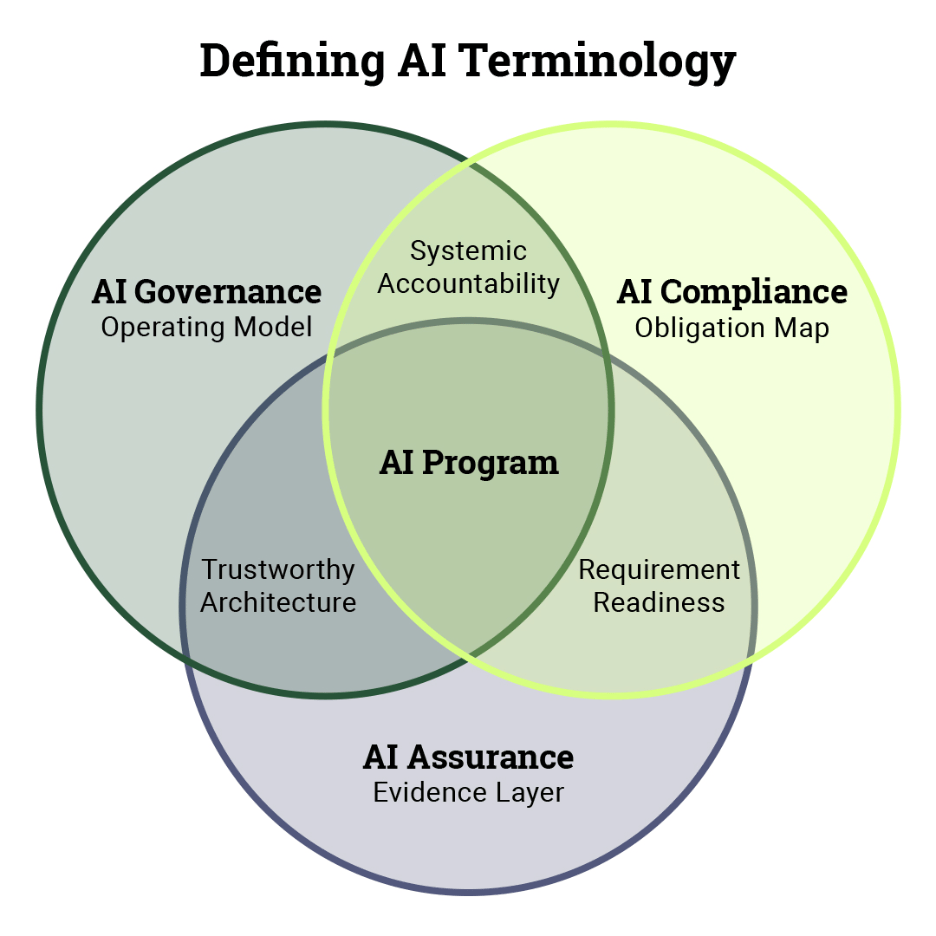
In short, Governance establishes how an organization directs and controls AI. Compliance determines whether AI use meets legal, regulatory, contractual, and policy obligations. Assurance provides evidence that AI systems are trustworthy, secure, reliable, and operating as intended.
Understanding the distinctions matter because AI risk is not confined to one department. It touches security, privacy, ethics, procurement, product development, legal exposure, customer trust, and operational resilience. A strong AI program needs all three disciplines working together. Without governance, AI efforts become fragmented. Without compliance, organizations may overlook obligations that carry legal or financial consequences. Without assurance, leaders may not have enough evidence to trust that an AI system is safe, secure, and fit for purpose.
What Is AI Governance?
AI Governance is the system of leadership, policies, processes, roles, decision rights, and accountability structures used to direct and control how artificial intelligence is developed, procured, deployed, monitored, and retired across an organization. Governance should aim for transparency and include relevant KPIs (Key Performance Indicators), KRIs (Key Risk Indicators), and KCIs (Key Control Indicators).
Put simply, AI Governance answers the question: Who is allowed to use AI, for what purpose, under what rules, and with what oversight? It is the organizing layer that makes responsible AI possible. Governance defines risk appetite, establishes approval pathways, assigns ownership, requires documentation, and creates escalation channels when AI risks exceed acceptable thresholds.
AI Governance is especially important because AI systems can behave differently from traditional software. Their performance can change over time, outputs may be difficult to explain, training data may introduce bias, and integrations can create downstream effects that are not obvious during initial deployment. Governance provides the operating model for identifying those risks early and making responsible decisions as AI becomes embedded in business operations.
It’s worth noting that AI Governance tools, while appealing, are not necessarily supporting effective governance strategies. These tools often provide isolated pockets of capability, while leaving noticeable gaps that can leave risk unaddressed and open unintended vulnerabilities.
What Is AI Compliance?
AI Compliance is the process of identifying, interpreting, implementing, and demonstrating adherence to the laws, regulations, standards, contractual requirements, internal policies, and industry obligations that apply to an organization’s AI systems and AI-enabled activities.
AI Compliance answers the question: Are we meeting the external obligations that apply to our AI use? Those obligations may come from emerging AI-specific laws, sector regulations, privacy rules, consumer protection requirements, anti-discrimination laws, intellectual property considerations, contractual commitments, security standards, or customer expectations. For multinational organizations, the answer may vary by geography, business unit, data type, use case, and role in the AI value chain.
Organizations may use voluntary frameworks and standards to structure compliance readiness even when formal legal requirements are still evolving. For example:
- ISO/IEC 42001 establishes requirements for an AI management system that can help organizations create consistent and auditable practices for responsible AI.
- The EU AI Act applies a risk-based approach and creates different obligations depending on whether an organization is a provider, deployer, importer, distributor, or other participant in the AI ecosystem.
- An AI Agent can be compliant with AIUC-1as this compliance is designed for a particular AI implementation.
These frameworks can become important evidence for regulators, customers, auditors, and business partners.
In practice, an AI Compliancy program should include a regulatory inventory. This will drive the obligations for an organization. Compliance teams should work closely with security, privacy, legal, procurement, and business leaders to ensure obligations are translated into operational controls. Otherwise, AI Compliance risks becoming a checklist exercise disconnected from how AI is actually used.
What Is AI Assurance and AI Security Assurance?
AI Assurance is the set of activities used to evaluate and provide confidence that an AI system is generally operating as intended in its real-world context. But when security professionals use the term “AI Assurance,” they’re likely talking more specifically from a cybersecurity and compliance standpoint. To them, AI Security Assurance is the process of validating whether AI systems and AI-enabled environments are effectively complying with the applicable frameworks.
AI Assurance, in this case, answers the question: Can we prove that our AI systems are compliant with the relevant standards? Assurance turns governance expectations and compliance requirements into proof. That proof may include risk assessments, control testing, model validation, red teaming, security testing, bias and fairness evaluation, explainability review, privacy assessment, audit trails, incident response testing, and continuous monitoring. In essence, the goal is to evaluate and prove model integrity, performance, and quality.
AI Security Assurance is becoming more urgent as organizations connect AI tools to sensitive data, internal systems, business workflows, and customer-facing applications. A chatbot that only answers public FAQs has a different risk profile than an AI agent that accesses customer records, writes code, summarizes legal contracts, or triggers business processes. The more autonomy, access, and business impact an AI system has, the stronger the assurance activities should be.
How the Three Terms Work Together
The easiest way to understand the relationship is to think of AI Governance as the operating model, AI Compliance as the obligation map, and AI Assurance as the evidence layer.
AI Governance defines who owns AI risk, how decisions are made, what policies apply, and how AI use aligns with the organization’s values and risk appetite. AI Compliance identifies what the organization must do to meet applicable obligations and demonstrate readiness to regulators, customers, auditors, and partners. AI Assurance evaluates whether the AI system and its controls actually work as intended.
Building a Practical AI Operating Model
Organizations can begin by creating a shared glossary that defines AI Governance, AI Compliance, AI Assurance, and AI Security Assurance in business terms. From there, they should inventory AI tools and use cases, classify risk levels, identify applicable obligations, and define review requirements based on the sensitivity and impact of each system. A marketing content assistant may require acceptable use guidance and data restrictions. A hiring, credit, healthcare, insurance, or security decision-support tool may require much more rigorous assessment, testing, documentation, and monitoring.
It is also important to avoid overengineering the program at the start. An effective AI operating model should be scalable. Begin with clear definitions, ownership, policies, and intake processes. Then mature toward more formal risk assessment, third-party review, control testing, audit readiness, and continuous assurance. The goal is not to slow AI adoption; it is to make AI adoption repeatable, defensible, and aligned with business objectives.
Shared Definitions Create Shared Accountability
AI Governance, AI Compliance, and AI Assurance are connected, but each plays a distinct role. Governance establishes direction and accountability. Compliance maps and satisfies obligations. Assurance provides evidence that AI systems are trustworthy, secure, and operating as intended. When these terms are clearly defined, organizations can align executives, technical teams, legal stakeholders, compliance leaders, and business owners around a common approach.
That alignment is becoming essential. AI is no longer a future-state technology initiative; it is already embedded in everyday workflows and strategic decisions. Organizations that define these terms now will be better positioned to innovate responsibly, prepare for regulation, protect customers, strengthen security, and demonstrate trust. In the AI era, clarity is not a formality. It is a control.
Authors